
Fire evacuation roll call
When the alarm goes, the book is inside the building you have just left
Your fire marshal is stood at the muster point in the rain, trying to work out whether the two contractors from this morning are out. The register that would tell them is on the reception counter, forty metres inside a building nobody is allowed to re-enter.
A fire roll call system included in the kiosk platform at £150 a month plus VAT. Not an add-on.
The problem with paper
Three ways the book fails at exactly the wrong moment
A visitor book is a perfectly good record of a normal Tuesday. It is a poor register for the four minutes after an alarm, and those are the only four minutes it exists for.
It is inside the building
The book lives on the reception counter, which is the room everyone has just been told to leave. Somebody either goes back for it or the roll call happens from memory.
It is one door out of several
The contractor who arrived at the goods-in gate never walked past reception. Neither did the engineer let in through the side door at seven in the morning.
Nobody signs out
Signing in feels like a courtesy, signing out feels like nothing. So the book over-counts, your marshal reports people missing who left at eleven, and the fire service searches a building for them.
See it work
A fire roll call, start to finish, in 100 seconds
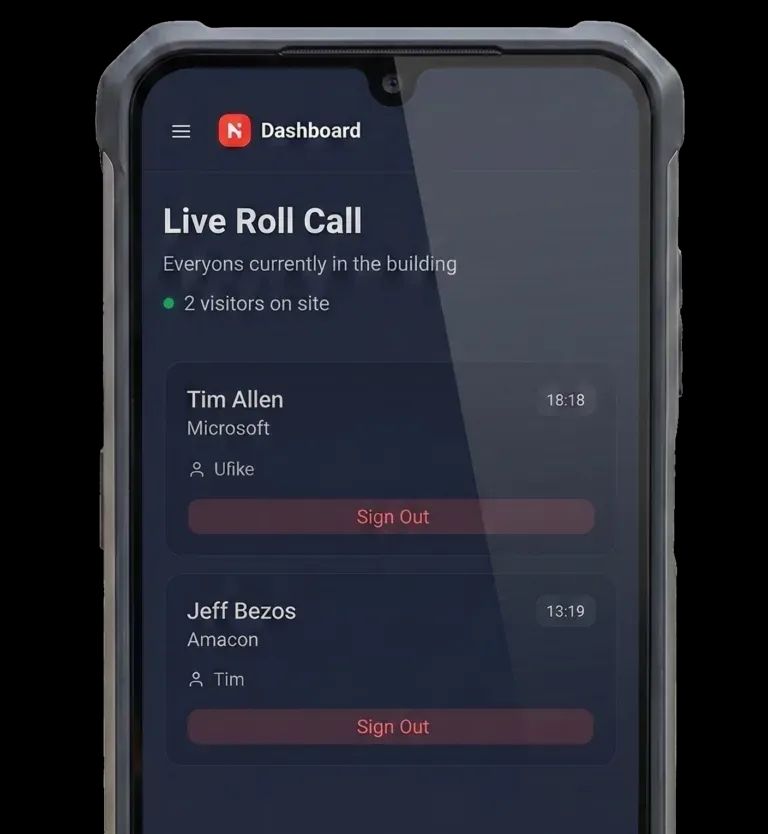
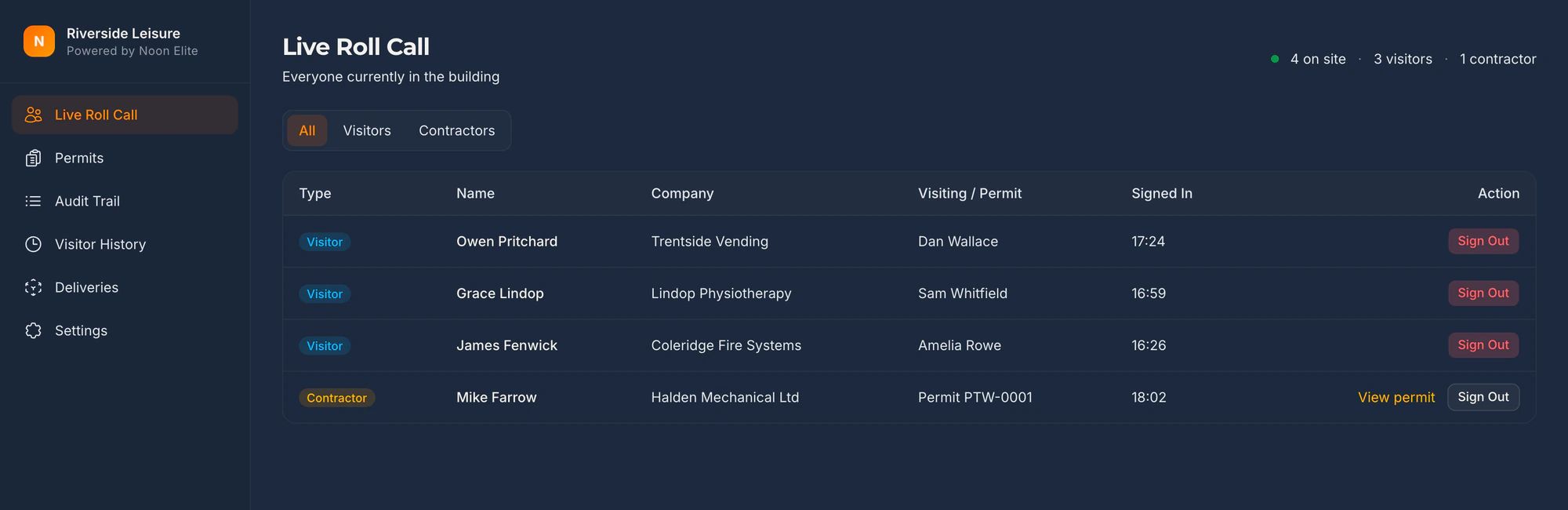
A visitor signs in on the iPad. The alarm goes. The marshal opens the live list on their phone at the muster point and reads off who is still on site. Nobody goes back inside for the book.
The player loads from YouTube only when you press play. Nothing is sent to Google before that. What happens when you do.
At the muster point
The list is on the phone already in their pocket
That is the whole roll call system. No app, no login to remember under pressure, no second device that needs charging. Your marshal opens a page and reads names off it.
- Everyone currently signed in, on any phone, without going back inside
- Visitors and contractors on the same list, with any driver who signed in rather than just dropping off
- Updates as people sign out, so the count is what it is now, not this morning
- Works on mobile data if the alarm has taken your WiFi with it
- Nothing to install: the marshal opens a link, not an app
Where the duty comes from
What the Fire Safety Order actually asks of you
Worth being precise, because a lot of people selling this are not. There is no line in the Regulatory Reform (Fire Safety) Order 2005 that says “you must hold a roll call”. What it says is that you must have suitable evacuation procedures and be able to put them into effect. Accounting for people at the assembly point is how nearly every fire risk assessment discharges that — and it will be your assessment, not the Order, that names it.
Article 9
A suitable and sufficient fire risk assessment
Yours will say something about how people are accounted for after an evacuation. It is worth reading that sentence again, because it is the standard you are actually being held to.
Article 15(1)(a)
Procedures for serious and imminent danger
The responsible person must establish, and where necessary give effect to, appropriate evacuation procedures. Getting everybody out is half of it. Knowing everybody is out is the other half.
Article 15(1)(b)
Enough competent people to run them
A sufficient number of competent persons nominated to implement the evacuation. Competent means equipped to do the job, and a marshal counting heads from memory in the rain is not well equipped.
Article 21
Training
Those people have to be trained in the procedures. A marshal who has never opened the list before the day of the alarm has not really been trained on it.
And the practical test underneath all of it
An evacuation is finished when everybody is out, accounted for, and the responsible person can say so to the fire and rescue service with confidence. If the honest answer to “is everyone out?” is “we think so”, that is the gap — whatever the paperwork says.
Being straight with you
What this is and is not
- It counts who signed in on the kiosk. Visitors and contractors, and a driver who signs in as one. A courier who only uses the delivery drop-off is logged but is not signed in, so is not on this list; if drivers go beyond goods in at your site, have them sign in. If your own staff clock in on a different system, or do not clock in at all, your roll call is this list plus whatever covers them — and that is a decision to make now rather than at the muster point.
- It does not replace your fire risk assessment. We are not fire risk assessors. The assessment, the drills and the procedures stay with your responsible person; this is a tool for one step of one of them.
- It does not detect a fire. It has nothing to do with your alarm panel, your detection or your suppression. It is a register that happens to be readable outside the building.
- It is only as good as your sign in discipline. If people walk past the kiosk, the list is wrong in exactly the way the book was. The difference is that a kiosk at the door with a printed badge is much harder to walk past than a biro on a counter.
The full kiosk, modules and pricingContractors on site as well as visitorsA site running it todayFree fire drill record template
Before you ask
The questions people ask about roll calls
What is a fire roll call system?
Whatever your site uses to know, at the assembly point, who is still inside. There are three kinds in use: a paper register somebody has to carry out, a printout from a clocking or access control system, and a live digital list that a marshal reads from a phone. Ours is the third, and it covers the people a clocking system does not: the visitors, contractors and drivers who have signed in on the kiosk. It is not a fire alarm or a detection system, and it does not replace the procedures in your fire risk assessment; it is the register those procedures rely on, readable outside the building.
Is a roll call the same as mustering?
Yes. Roll call, mustering and emergency mustering all describe the same step: accounting for everybody at a safe place after an evacuation. Muster point and assembly point are the same place, and a mustering system and a roll call system are the same kind of tool. Mustering is the more common word on larger and higher hazard sites, and in access control brochures; UK fire guidance for factories and warehouses says assembly point and roll call, which is why this page mostly does.
Is there a fire roll call app?
Not one you install, and that is deliberate. The marshal opens a link in the browser of the phone already in their pocket and the live list is there: no app store, no update waiting, no login to remember in the rain, and it works on mobile data if the alarm has taken the WiFi with it. If you searched for a roll call app because you want the list on a phone at the assembly point, that is exactly what this is. It just does not need installing first.
Is a fire roll call a legal requirement in the UK?
Not in those words. The Regulatory Reform (Fire Safety) Order 2005 does not use the phrase. Article 15 requires the responsible person to establish appropriate evacuation procedures and nominate enough competent people to carry them out, and Article 9 requires a fire risk assessment. Almost every assessment discharges Article 15 by naming a way of accounting for people at the assembly point, so in practice the roll call is a requirement of your own assessment, and that is the document a fire officer will hold you to.
Where should a roll call be carried out?
At the assembly point named in your fire emergency plan, and nowhere else. The government guide for factories and warehouses says the assembly point should be far enough from the building that people are not at risk from the fire, and positioned so that it does not obstruct the fire and rescue service or its appliances. The roll call is taken there by the person nominated to take it. It is never taken by going back inside for a book, which is the reason this page exists.
Who is responsible for the roll call?
The responsible person under the Order, which for a factory is normally the employer or whoever controls the premises. In practice they nominate competent people, usually called fire marshals or fire wardens, under Article 15(1)(b), and the marshals take the count and report it to whoever is liaising with the fire and rescue service on arrival. Nominating them is not enough on its own: Article 21 requires them to be trained in the procedure.
Should visitors, contractors and delivery drivers be included in the roll call?
Yes. The duties in the Order are owed to relevant persons, which Article 2 defines as anyone who is or may be lawfully on the premises, not only employees. A roll call that covers staff and leaves out the two contractors on the roof and the driver in the yard is a roll call of the people least at risk. This is also why the roll call and the visitor sign in are the same problem: whoever is on the register is who you are counting.
How long should a fire roll call take?
No time is set in law. The practical test is whether, when the fire and rescue service arrives, you can tell them straight away whether anyone is unaccounted for and where that person was last known to be. Every minute spent finding the book, reading handwriting or ringing round hosts is a minute the answer is “we think so”.
What happens if somebody left without signing out?
They are reported as unaccounted for, and somebody may search a building for a person who went home at eleven. That is the over-count failure, and paper is bad at it because signing out feels optional. A kiosk gives signing out its own button on the screen and, where badges are printed, a badge to hand back, and the live list updates the moment it is pressed, so the count at the muster point is closer to the truth than the book ever was.
- Regulatory Reform (Fire Safety) Order 2005Articles 2, 9, 15 and 21, which are the ones quoted on this page.
- HM Government, fire safety risk assessment: factories and warehousesThe guide that covers assembly points, roll calls and the emergency plan for this kind of site.
General information about the Order and a published guide, not fire safety advice. Your fire risk assessment governs.
Also asked of sites like yours
The other things somebody may ask you to evidence
Each of these is a page about one standard, one duty or one visitor, written the same way as this one: what it actually asks for, what an iPad at reception records towards it, and where it does not help.
- GDPR and the visitor book
- CMMC physical security
- ISO 27001 visitor access
- AEO visitor access control
- BRCGS visitor control
- Contractor management
- HSE inspection records
- ISO 45001 contractor control
- Sign in sheet template
- Visitor health questionnaire template
- Contractor induction template
- Permit to work template
- Hot work permit template
- Fire drill record template
Next step
Run the question past your own site
Fifteen minutes on the phone. Tell us how a roll call works at your site today and how many gates people come through, and we will tell you straight whether this is worth your time.
Book a 15 minute callNo site visit needed and nothing to install. If it is not a fit we will say so on the call.
Would rather email? [email protected]
Not the person who signs it off? Send them the one page business case