
HSE inspections and the front desk
The inspector asked who was on site that day. Which book did you reach for?
A health and safety inspector does not start in the factory. They start at reception, with a date, a name, and a question about a contractor. What happens in the next ten minutes decides whether the rest of the visit is a conversation or an investigation.
From £150 a month plus VAT, iPad and stand included. We are not health and safety consultants.
Why they come
Three reasons an inspector is stood at your reception
Only one of them means something has already gone wrong. All three begin with the same question, and the answer to it lives at the front desk or nowhere.
Something has been reported
A RIDDOR report, an injury to a contractor, a near miss somebody rang in about. The inspector arrives with a date and wants to know who was on site on it, what they were there to do, and who had agreed to it.
A complaint or a concern
An employee, a neighbour or a contractor’s own firm has raised something. The visit is unannounced, because it usually is, and the first question is asked at reception.
A proactive inspection
HSE runs inspection programmes by sector, and manufacturing is a regular one. Nothing has gone wrong. They still want to see how contractors are managed, because that is where a lot goes wrong.
What they are allowed to do
Section 20, and why the visitor book is inside it
Section 20 of the Health and Safety at Work etc. Act 1974 gives an inspector a list of powers. Four of them are exercised at reception before anyone has walked onto the floor.
Section 20(2)(a)
To enter
At any reasonable time, or at any time where the situation may be dangerous. There is no appointment, and reception is where the visit begins.
Section 20(2)(k)
To require documents
To require the production of, inspect and copy any book or document that the law requires you to keep, and any other document they need to see for the purposes of their examination. That second half is the one that reaches the visitor book.
Section 20(2)(j)
To ask questions
To require anyone they think can help to answer questions and sign a declaration of the truth of the answers. “Who let this contractor start work?” is one of those questions.
Section 20(2)(e) and (f)
To measure, photograph and take
Measurements, photographs, recordings, and samples. A photograph of the open page of your visitor book is an entirely ordinary thing for an inspector to take.
None of this is hostile. It is what the visit is. The difference between a site that has the record and one that does not is not whether the powers get used; it is how long the inspector is on site using them, and under Fee for Intervention that time has a price.
On the day
Five questions about people, and where the answers come from
These are the questions a reception process either answers or does not. Competence, supervision and the safe system of work are questions for other rooms.
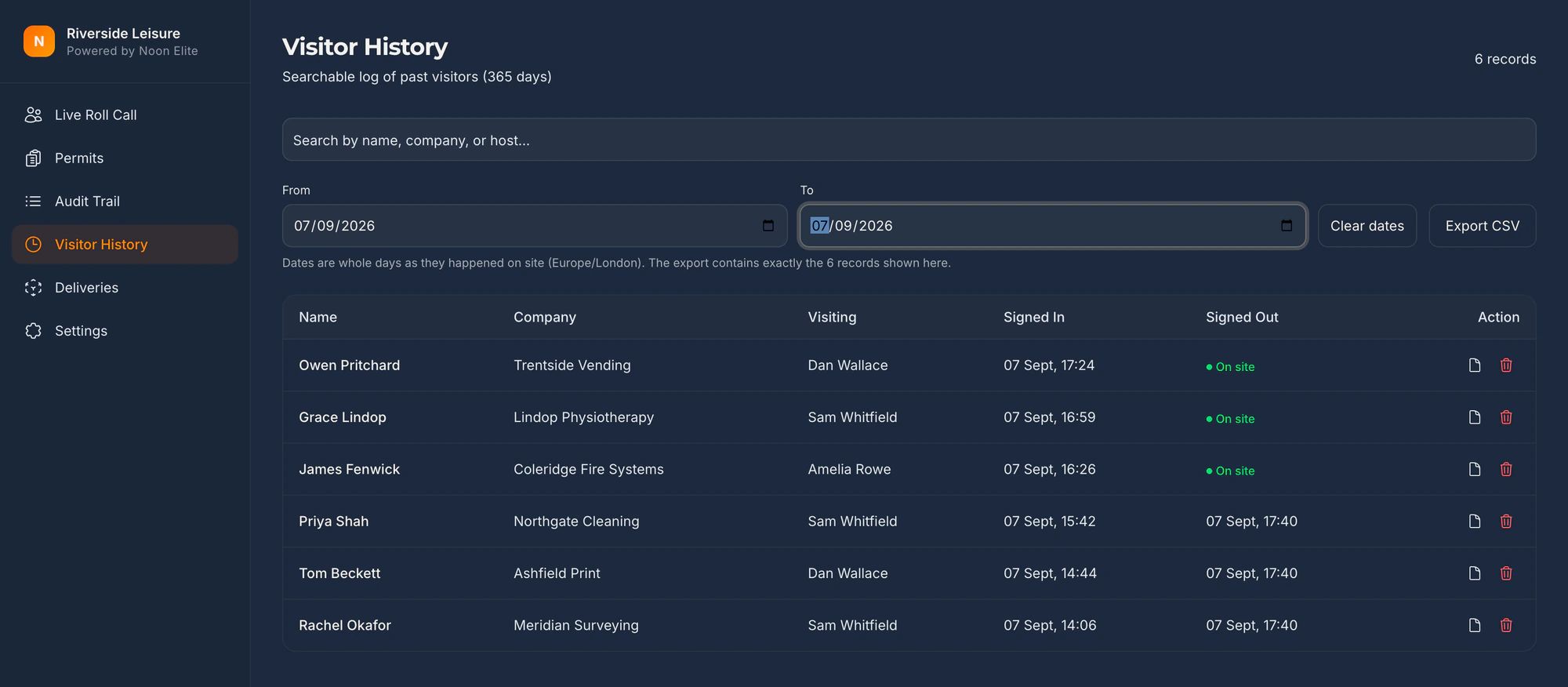
- Who was on site on the day?A record you can filter to that date, listing every visitor and contractor with their company, host, and the time in and out, exported to a file the inspector can take away.
- What was this contractor here to do, and who agreed to it?The visit tied to a named host, and where the permit module is used, the permit itself with the authorising name and time on it.
- Were they told your site rules and emergency arrangements?The rules and evacuation information shown on screen before sign in, acknowledged by name, with the timestamp of the acknowledgement stored against the visit.
- Did you receive their risk assessment and method statement?For contractors under a permit, the RAMS uploaded against the permit before arrival. For everyone else, this is a question for your procurement file rather than your reception.
- How do you know everybody got out during the alarm last month?The roll call as it stood at the time, which is the same register read from a phone at the muster point.
Where the duty comes from
Nothing says “keep a visitor book”. Four things say why you do.
Worth being precise, because a lot of people selling this are not. There is no statutory duty to keep a visitor log. There are duties to inform, co-ordinate and evacuate, and a record of who came in and what they were told is how a site shows it met them.
HSWA 1974, section 3
Duty to people who are not your employees
To conduct your undertaking so that, so far as is reasonably practicable, people not in your employment are not exposed to risks to their health or safety. Visitors and contractors are those people. It is the section most contractor incidents are prosecuted under.
MHSWR 1999, regulation 11
Sharing a workplace
Where two or more employers share a workplace, even temporarily, each has to co-operate and co-ordinate with the others on the measures they are taking. A contractor on your floor is a shared workplace for the day.
MHSWR 1999, regulation 12
Information for visiting workers
A host employer has to give the employer of any visiting worker, and the workers themselves, comprehensible information about the risks on site, the measures in place, and who is nominated to run the evacuation. This is the regulation your induction and site rules are discharging.
Fire Safety Order 2005, article 15
Evacuation procedures
Enforced by the fire and rescue authority rather than HSE, but the inspector will still ask how you accounted for people, because a contractor who was not on your list is a contractor nobody knew to look for.
Managing contractors the HSG159 wayPermits to work and RAMSThe roll call at the muster point
Before you ask
The questions sites ask after a visit
Can an HSE inspector ask to see the visitor book?
Yes. Section 20 of the Health and Safety at Work etc. Act 1974 lets an inspector require the production of any document they need to see for the purposes of their examination, inspect it and take copies. The visitor book is a document about who was on site, and after an incident it is usually one of the first they ask for. They can also photograph it as it stands, which is worth remembering when the last twenty entries are on an open page.
Is a visitor log a legal requirement in the UK?
There is no line in the Health and Safety at Work Act or its regulations that says you must keep a visitor book. What the law requires is that you give visiting workers information about risks and emergency arrangements (regulation 12 of the Management Regulations), co-ordinate with the employers you share the workplace with (regulation 11), and have evacuation procedures that account for everybody lawfully on the premises (article 15 of the Fire Safety Order). A record of who was on site, when, and what they were told is how nearly every site evidences all three. The book is not the duty. It is the evidence.
What is Fee for Intervention?
HSE’s cost recovery scheme. Where an inspector finds a material breach of health and safety law, HSE charges you for the time it spends identifying the breach, helping you put it right and following up, at an hourly rate it publishes and revises. Time spent waiting while somebody finds last year’s book counts. The rate is deliberately not quoted on this page, because it changes; the current figure is on the HSE page linked below.
Which records about contractors will an inspector expect to see?
Usually: how you satisfied yourself the contractor was competent before the job, their risk assessment and method statement for the work, what site induction they received and when, any permit to work for higher risk tasks with the name of whoever authorised it, and who was on site on the day in question. The first is a procurement record. The rest are the ones a reception process either produces or does not.
Who enforces health and safety at a factory, HSE or the council?
HSE for most factories and manufacturing sites. Local authority environmental health officers enforce at lower risk premises such as offices, shops and some warehousing, and the fire and rescue authority enforces fire safety at both. In practice the questions about who was on site are the same whoever is asking them.
Does a sign in kiosk make us compliant?
No, and anyone who tells you otherwise is selling. It produces a timestamped record of who came in, who they saw, what rules they acknowledged and when they left, and it puts your evacuation information in front of every visitor before they enter. Those are pieces of evidence towards duties that are yours. An inspector is interested in whether the contractor was actually managed, and the record only helps if what it records was real.
Being straight with you
What this does not do
- We are not health and safety consultants. This is general information about published law and published HSE guidance. Your risk assessments, your safe systems of work and your competence checks are yours, ideally with somebody qualified.
- A record is not a control. The inspector wants to know that the contractor was competent, briefed and supervised. A kiosk shows they were briefed and when. Competence is decided before they are booked, and supervision happens on the floor.
- It covers people who came through the door. If a contractor drives to the far gate and starts work without signing in, the record is wrong in exactly the way the book was. The kiosk makes that harder, with a badge and a host alert, not impossible.
- It does not replace your accident book or your RIDDOR duties. Reporting is yours. What the kiosk adds is the answer to the first question the report prompts: who else was there.
Sources
Check any of this yourself
- Health and Safety at Work etc. Act 1974, section 20The powers of inspectors, including the power to require and copy documents.
- Health and Safety at Work etc. Act 1974, section 3The general duty to people who are not your employees.
- Management of Health and Safety at Work Regulations 1999, regulations 11 and 12Co-operation between employers sharing a workplace, and information for visiting workers.
- HSE, what to expect when a health and safety inspector callsHSE’s own leaflet on the visit, from the other side of the counter.
- HSE, Fee for InterventionHow cost recovery works, and the current hourly rate.
- HSE, using contractors: a brief guide (INDG368)The short version of HSG159, which /contractor-management/ is built around.
General information about published law and HSE guidance, not health and safety advice. Section and regulation numbers are stable; HSE’s guidance and its hourly rate are revised, so follow the links.
Also asked of sites like yours
The other things somebody may ask you to evidence
Each of these is a page about one standard, one duty or one visitor, written the same way as this one: what it actually asks for, what an iPad at reception records towards it, and where it does not help.
- GDPR and the visitor book
- CMMC physical security
- ISO 27001 visitor access
- AEO visitor access control
- BRCGS visitor control
- Fire roll call
- Contractor management
- ISO 45001 contractor control
- Sign in sheet template
- Visitor health questionnaire template
- Contractor induction template
- Permit to work template
- Hot work permit template
- Fire drill record template
Next step
Tell us what the inspector asked for
Fifteen minutes on the phone. What they wanted, how long it took to find, and what you have been asked to do about it. We will tell you straight whether a kiosk at reception closes any of it.
Book a 15 minute callNo site visit needed and nothing to install. If it is not a fit we will say so on the call.
Would rather email? [email protected]
Not the person who signs it off? Send them the one page business case