
BRCGS and food manufacturing
Your auditor is the first visitor of the day, and the book is the first thing they sign
Before they have seen a single record, walked a single line or asked about a single allergen, they have stood at your reception counter, read the last page of your visitor book, and written their own name underneath. Clause 4.1.4 is the one they are quietly forming a view about while they do it.
From £150 a month plus VAT, iPad and stand included. We are not auditors or consultants.
What the Standard asks
One clause about the front door, and four that lean on it
Issue 9 does not have a visitor management section. It has one clause about controlling access, in the section covering external standards and site security, and four other places where the record that clause produces turns out to be the thing you need.
Clause 4.1.4
Access to the site is controlled
Policies and systems in place so that access by staff, contractors and visitors is controlled, with a visitor recording system, and with contractors and visitors — drivers named explicitly — made aware of the procedures for access. Only authorised people reach production and storage areas. This is the clause your reception book is being asked to satisfy.
Clauses 7.1.4–7.1.5
Contractor and visitor induction
External personnel are inducted before they go in: site hygiene rules, contamination control, personal hygiene, protective clothing, site security and allergen awareness. An induction is only evidence if you can show who received it and when.
Clauses 7.3.2–7.3.3
Medical screening
Anyone going into product areas, visitors and contractors included, completes a health questionnaire covering symptoms and recent contact with infection. It is the one question at your door that has to be asked before entry rather than filed after it.
Section 4.2
Food defence
What Issue 9 renamed site security. The assessment asks who could deliberately interfere with product and how you would know. Every answer to that starts with a record of who was in the building and who let them in.
Clause 3.11
Incident, withdrawal and recall
When something goes wrong you work backwards through what happened and who was present. A log you can filter by date and by company shortens that considerably.
Nothing in the Standard tells you to buy anything, and a paper book that is genuinely filled in every time can satisfy 4.1.4. The clause asks you to demonstrate control and awareness, and demonstrating is the word that does the work. Note that the two clauses in section 7 are not a log at all — they are questions that have to be answered before somebody goes in, which a book on a counter was never built to do.
At the door
What a food site gets that a general visitor log does not
The same iPad, showing a different declaration. On a food site the declaration is the point: a name and a time is a log, and a name, a time and an accepted hygiene declaration is a control.
The auditor signs in on it
Your BRCGS auditor is the first visitor of the day, and the sign in process is the first thing they experience on your site. It is a small impression that arrives before anything else does.
Induction and health declaration, by name
Jewellery, protective clothing, no glass or hard plastics, allergen awareness, and the health declaration you ask for under 7.3, put on screen in your wording, accepted before a badge prints, and stored against the person who accepted it with a timestamp.
A record for the traceability exercise
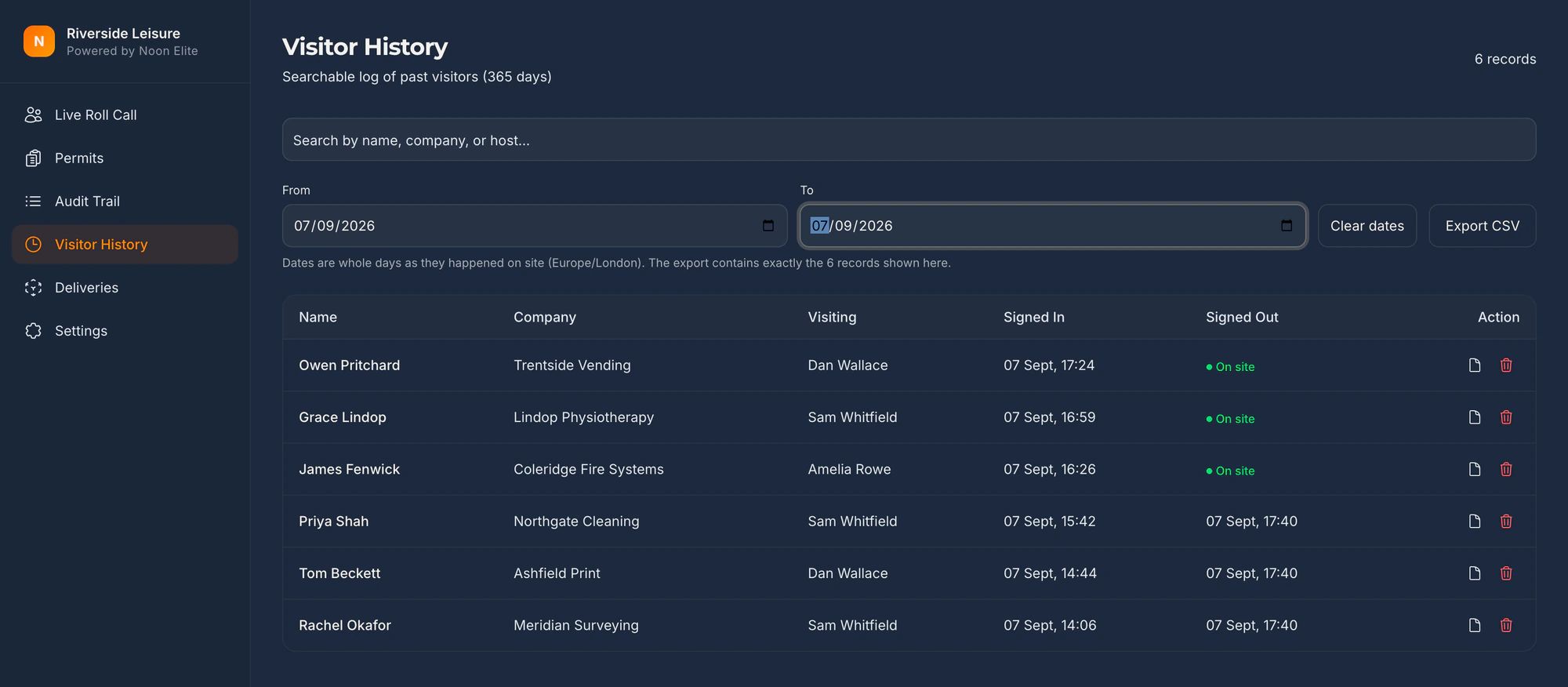
Filter by date, by company or by host and export it. Who was in the building on the day of the deviation stops being a question about a handwriting sample.
A roll call that includes the drivers
Goods in traffic is the part of the site most likely to be missed on an evacuation. If drivers sign in on the kiosk they are on the live list at the muster point with everybody else.
The kiosk in fullThe food sector page, without the clause numbersFree visitor health questionnaire templateContractors and RAMSThe book and UK GDPROur security and sub-processors
On the day
Five things an auditor asks at reception, and where the answers come from
None of these is difficult if the record exists. All of them are awkward if the answer starts with somebody going to look for last year’s book.
- Show me your visitor recording system.The kiosk itself, plus the records it holds, on screen at the desk you are stood at.
- How do contractors know your site rules?They are shown them at sign in and acknowledge them by name, and the acknowledgement is stored with the visit.
- How do you distinguish an approved visitor from anyone else on the floor?A printed badge with the name, the host, the date, and a colour that says what clearance the person holds.
- Who was on site on the day of this non-conformance?A filtered list, exported to a file that opens without our software.
- What happens when goods in is busy and reception is not staffed?The kiosk still captures the arrival and alerts the host in Teams or Slack, so the record does not depend on somebody being at the desk.
Before you ask
The questions food sites ask on the first call
Does BRCGS require an electronic visitor system?
No. Clause 4.1.4 asks for a visitor reporting system and for access to the site to be controlled. It does not specify the technology, and a well-run paper book that is actually filled in can satisfy it. What the clause asks you to demonstrate is control and awareness — that visitors and contractors were made aware of the access procedures — and demonstrating that is where paper tends to struggle.
Which BRCGS issue is current?
Issue 9 of the Global Standard for Food Safety, which has applied to audits since February 2023. Issue 10 has been through public consultation but has no confirmed publication date or transition timetable, so Issue 9 is what an audit currently works from. Site security and visitor control have sat in clause 4.1 across several issues, so the substance is unlikely to move much.
Can visitors acknowledge hygiene rules on the kiosk?
Yes. The declaration is written per site, so jewellery, protective clothing, glass and hard plastics, allergen and medical declarations can all go on screen and be accepted before a badge is issued. The acceptance is stored against the named visitor with a timestamp and the exact wording they accepted.
Do delivery drivers need to sign in?
Clause 4.1.4 names drivers explicitly among the people who must be made aware of site access procedures. Whether they come to reception or sign in at a goods in gate is a site decision, but if they are on your premises they should be on your record and on your roll call.
Does a health questionnaire count as special category data?
Health information is special category data under UK GDPR Article 9, so a medical declaration needs more care than a name and a company. In practice most sites avoid holding the detail: the kiosk shows your declaration and records that it was accepted. It does not ask for or hold an account of anybody’s symptoms. Where you draw that line is a decision for your own data protection advice, and it is worth taking before the declaration is written rather than after.
Can the kiosk go in the factory?
It goes at reception or at a gatehouse, on the office side of the hygiene barrier. It is a consumer tablet in a stand, not a washdown-rated device, and we would not put one anywhere it needed to be. Sites with a separate goods in entrance usually take a second unit there rather than moving the first.
Being straight with you
What this does not do
- We are not a certification body, a BRCGS auditor, an Approved Training Partner or a food safety consultancy. This is general information about a published standard, not certification advice.
- The five clauses on this page are five out of several hundred. Your HACCP plan, your prerequisite programmes and your traceability system are all still yours.
- The kiosk lives at reception, on the office side of the hygiene barrier. It is not a low-care or high-care area device and we would not claim otherwise.
- A kiosk records that somebody acknowledged your hygiene rules. Whether they then followed them is a supervision question, and no software answers it.
- If your auditor has raised a specific non-conformance, bring their wording to the call and we will tell you honestly whether this closes it.
Sources
Check any of this yourself
- BRCGS Global Standard Food SafetyThe Standard itself, and the current issue and transition position.
- BRCGS, Issue 10 developmentWhere the next issue has got to. Worth a look before you plan anything around a date.
- Food Standards Agency, managing food safetyThe statutory baseline underneath the certification scheme, which applies whether or not you are certified.
General information about a published standard, not certification advice. Clause numbers move between issues; confirm against your own copy of the Standard.
Also asked of sites like yours
The other things somebody may ask you to evidence
Each of these is a page about one standard, one duty or one visitor, written the same way as this one: what it actually asks for, what an iPad at reception records towards it, and where it does not help.
- GDPR and the visitor book
- CMMC physical security
- ISO 27001 visitor access
- AEO visitor access control
- Fire roll call
- Contractor management
- HSE inspection records
- ISO 45001 contractor control
- Sign in sheet template
- Visitor health questionnaire template
- Contractor induction template
- Permit to work template
- Hot work permit template
- Fire drill record template
Next step
Tell us what your auditor said about reception
Fifteen minutes on the phone. How many gates, how much goods in traffic, and what your last audit raised. We will tell you straight whether a kiosk closes any of it.
Book a 15 minute callNo site visit needed and nothing to install. If it is not a fit we will say so on the call.
Would rather email? [email protected]
Not the person who signs it off? Send them the one page business case