
Food and food packaging manufacturing
Audit-ready visitor and contractor health declarations, without the paper forms
Every food and packaging site asks visitors the same questions at the door: any sickness in the last 48 hours, any cuts, any contact with infection. Most still ask them on a clipboard sheet that gets filed, or does not. The kiosk puts your declaration on an iPad at sign in, stores the acceptance against the person and the time, and has it ready when the auditor asks.
From £599 setup and £150 a month plus VAT, iPad and stand included. Running today at a Derbyshire packaging site.
The problem
Paper questionnaires are easy to hand out and hard to stand behind
The questions are right. The sheet is the weak point: it depends on somebody handing it over, somebody reading it, somebody filing it, and somebody finding it a year later.
Sheets go missing
A clipboard by the door works until the day is busy. A driver signs the book and skips the sheet; a contractor’s declaration ends up in the van. The gap is invisible until somebody asks for that date.
Nobody reads the answers
A questionnaire is a control only if a yes is seen before the person goes through the door. On paper it is read, if at all, when the sheet is filed.
Audit day is a paper hunt
BRCGS, SALSA and your retail customers’ auditors all ask the same thing in different words: show me who was on site, and show me they were screened. On paper that is an afternoon in a filing cabinet, and the folder for one month is never quite complete.
Health answers on an open counter
Illness questions are health data, which UK GDPR treats as special category. A stack of completed forms on the reception desk, readable by the next visitor, is the kind of thing an audit notices even when the questions were right.
How the kiosk handles it
The same declaration, accepted at sign in, kept where you can find it
An iPad at reception, with your declaration on it. On a food site the declaration is the point: a name and a time is a log, and a name, a time and an accepted declaration is a record you can put in front of an auditor.
Declaration at sign in
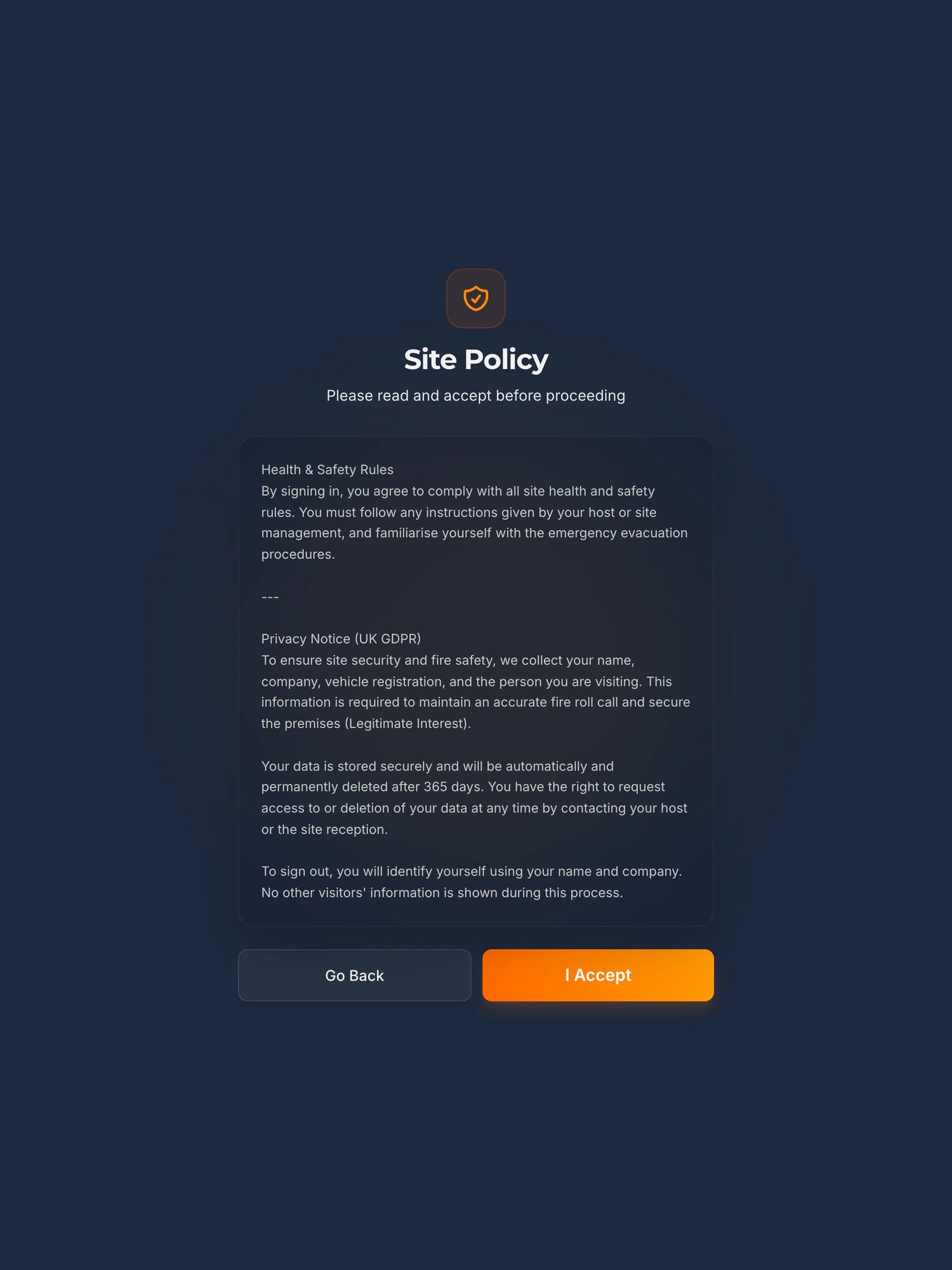
Your health declaration and hygiene rules, on screen, accepted by the visitor before they are let through. Nobody signs in without accepting them. Anyone who cannot confirm the declaration goes back and speaks to their host, and the host decides.
Timestamped, against a name
Every acceptance is stored with the person, their company, their host, the time and the exact wording they accepted. Filter by date or by company and export it. The record for a customer audit or a traceability exercise takes seconds, not an afternoon.
Kept twelve months, then gone
Records are retained for twelve months as standard, or the period your customer or your standard asks for, and deleted after it. Nothing sits in a drawer past its date.
Fire roll call included
Everyone signed in — visitors, contractors, drivers — is on a live list readable from any phone at the assembly point. No sheet to carry out, and nobody goes back in for the book.
The kiosk in fullIf you are certified to BRCGS, the clause by clause pageThe roll call, on its ownWhere the data lives
Proof
Running at a packaging site since August 2026
JK Powell make metal packaging for the food industry in Derbyshire. They swapped their paper book for the kiosk in under an hour. Visitors and contractors sign in on it, deliveries are logged on it, and the marshal reads the fire roll call from a phone. It is the only customer we name, because it is the only one we have permission to.
The Kiosk does everything we need it to simply and reliably at a great price.
- Metal packagingFor the food industry. Derbyshire
- Under an hourFrom box to first sign in
- August 2026Running continuously since
What it costs
One price, in public
Setup from £599, then £150 a month plus VAT. The iPad, the stand, hosting and support are included, the hardware is replaced if it fails, and nothing is charged per visitor or per user. A second unit for a goods in gate is priced on the call.
Every price, and what is not charged forHow it compares to Sign In App and EpturaThe one page business case, for whoever signs it off
Who you are dealing with
You will always talk to the person who built it
Noon Elite is me, Ben Noon. I am a software engineer of fourteen years and I run this from Derbyshire, which means I install in person around the East Midlands and can change your declaration wording because you asked on a Tuesday. If something stops working at your reception desk, you speak to the person who wrote the code.
Before you ask
The questions food and packaging sites ask on the first call
What should a visitor health questionnaire for a food site ask?
Whether the person has had vomiting or diarrhoea in the last 48 hours, whether anyone in their household has, whether they have a fever or an infectious illness, any skin infection, boil, septic cut or open wound, any discharge from eyes, ears or nose, and whether they have returned from abroad recently with a stomach upset. Then the site’s own hygiene rules, acknowledged one by one, and a host’s sign off recording the outcome. Our free template asks exactly that. The kiosk puts your own declaration on screen, to be accepted before sign in.
Do food sites have to ask visitors health questions?
Not in those words, and not by a single law. Food hygiene law requires that anyone with an illness that could be passed on through food is kept away from it, and the certification standards and retailer codes that food and packaging sites work to extend that expectation to visitors and contractors entering product areas. What is asked, and how it is recorded, is set by your own standard and your own procedures. That an auditor will ask to see it is a safe assumption.
Does the kiosk store somebody’s medical answers?
No. The kiosk shows your declaration and records that the visitor accepted it, with the wording and the time. It does not ask for or store an account of anybody’s symptoms, so special category health data stays out of the system. Anyone who cannot confirm the declaration speaks to their host, and what happens next is your record, not the kiosk’s.
We are SALSA certified, not BRCGS. Does this still fit?
Yes. The declaration and rules are written per site, so what your standard, your customer or your own technical manager asks for is what goes on screen. The record is the same whichever scheme you certify to: who was here, when, who they saw and the exact wording they accepted.
What about contractors and delivery drivers?
Anyone who signs in as a visitor accepts the same declaration, whether they are a guest, a contractor or a driver, and is on the record and the roll call. With the permit to work module, contractors on a permit arrive through their own flow and are on the roll call too. A courier leaving a parcel is logged as a delivery, not as a person on site. Whether a driver who stays in the yard signs in is a site rule, and it is yours to set.
Can the kiosk go on the factory floor?
No. It goes at reception or at a gatehouse, on the office side of the hygiene barrier. Sites with a separate goods in entrance usually take a second unit there rather than moving the first.
Will this get us through our audit?
No system does, and we would not sell you one that claimed to. What the kiosk gives you is a complete, timestamped record of who was on site and the declaration they accepted, retrievable in seconds on the day. Whether your system as a whole is sound is the auditor’s judgement to make.
Being straight with you
What this does not do
- We are not a certification body, an auditor or a food safety consultancy. Nothing here is certification advice, and nothing here quotes a clause, because your standard and your customer codes are yours to read.
- The kiosk supports the records a site is expected to keep. It does not pass an audit; your whole system does, and an auditor looks at far more than the front door.
- It lives at reception, on the office side of the hygiene barrier. It is a consumer tablet in a stand, not a washdown-rated device, and we would not put one anywhere it needed to be.
- It records that somebody accepted your declaration and acknowledged your rules. Whether they then followed them is a supervision question, and no software answers it.
- We have one live site, and it makes packaging rather than food. The case study is the only customer proof we have, and we would rather you read it than took our word.
Still on paper for now?
Take the questionnaire, free
A one page visitor and contractor health questionnaire for food sites, with the hygiene rules acknowledgement, the host’s sign off and the privacy line for health data already written. Print it, or download the PDF or the Word version and put your own site rules in. No form to fill in to get it.
The visitor health questionnaire templateThe sign in sheets that go with it
A starting template. Adapt it to your own site rules and to the standard you are certified to; it is not certification advice.
Also asked of sites like yours
The other things somebody may ask you to evidence
Each of these is a page about one standard, one duty or one visitor, written the same way as this one: what it actually asks for, what an iPad at reception records towards it, and where it does not help.
- GDPR and the visitor book
- CMMC physical security
- ISO 27001 visitor access
- AEO visitor access control
- BRCGS visitor control
- Fire roll call
- Contractor management
- HSE inspection records
- ISO 45001 contractor control
- Sign in sheet template
- Visitor health questionnaire template
- Contractor induction template
- Permit to work template
- Hot work permit template
- Fire drill record template
Next step
Tell us what your last audit said about reception
Fifteen minutes on the phone. Which standard you work to, how many doors people come through, and what you ask at the door today. We will tell you straight whether a kiosk is worth your time.
Book a 15 minute callNo site visit needed and nothing to install. If it is not a fit we will say so on the call.
Would rather email? [email protected]
Not the person who signs it off? Send them the one page business case