
UFAS Scheme Rules and Standard 2024
UFAS visitors: what the 2024 Standard asks a feed mill to show about visitors, contractors and drivers
A feed mill’s visitors arrive at the weighbridge, and the 2024 Standard names vehicle drivers in three of the four clauses that reach it. One clause asks for security measures against unauthorised access, and the Standard’s own interpretation of it names the control of visitors and contractors. This page quotes all four from the Standard, keeps the interpretation labelled as interpretation, and says what an iPad at the gate records towards each.
Sign in on a demonstration kiosk, then open the fire roll call on your phone. Do not enter real details: everything typed is deleted within the hour.
From £150 a month plus VAT, iPad and stand included. We are not assessors or consultants.
What the Standard asks
One clause about security, three about what people are told, and the codes they apply to
Section F of the Standard is Premises, Equipment, Personnel and Own Transport, and subsection F1 is Premises. Each requirement is printed with a label, UPDATED or NEW, and some carry an Interpretation and Further Information paragraph under them. The page quotes the requirement and, where it matters, the interpretation, and says which is which.
F 1.2, requirement
Security measures against unauthorised access
The Participant must ensure that appropriate and proportionate security measures are planned and implemented to monitor and prevent unauthorised access at all times wherever this is deemed necessary to maintain feed safety.
The requirement itself says nothing about visitors. The Standard’s own Interpretation paragraph under it does: these measures may include physical security, site access control, CCTV, control of visitors / contractors, etc. including during non-operational periods. That is interpretation, not requirement, and the page keeps the two apart. What both agree on is that knowing who was on site, and when, is part of preventing unauthorised access.
F 1.6, requirement, new in 2024
Enteric disease, and who has to be told
Where this may compromise food/ feed safety, employees, contractors, and visitors (including vehicle drivers) must be advised that entering the site when suffering from a communicable enteric disease is not permitted.
New in the 2024 Standard. It does not ask for a questionnaire or a declaration of health; it asks that people are advised, before they enter, and it names vehicle drivers. Advised is the word a record can evidence: what they were told and that they acknowledged it.
F 1.4, requirement
Eating, drinking, smoking and vaping
Employees, contractors and visitors (including vehicle drivers) must be made aware of controls on eating, drinking and smoking/ vaping in areas where these activities may compromise food/ feed safety.
Made aware, again with drivers named. A rule on a sign at the weighbridge is one way; a rule the driver accepted by name before the sign in completed is a way you can show eight months later.
F 1.5, requirement
Workwear for visitors and drivers
In areas where there is a risk of contaminating food/ feed, employees, contractors and visitors (including vehicle drivers) must wear suitable and hygienic workwear.
A rule about what happens past the door, which a sign in system cannot enforce. What it can do is put the rule in front of the visitor before they go in, with the rest of your site rules, and record that they accepted it.
F1 Premises, activity codes
Which sites these apply to
F1 Premises Pa, B, C, R
The subsection heading carries the activity codes it applies to, and the Activity Code Matrix gives code C, Compound Feeds, as Section A plus Sections C, D, E and F among others. A compound feed mill or premix plant is inside F1. A packaged merchant, Pa, and a bulk merchant, B, are too. Check your own certificate’s codes against the matrix rather than this page.
Quoted from the UFAS Scheme Rules and Standard 2024, Version 1.1, effective from 1 April 2025, published by AIC and read on 26 September 2026. Nothing in the Standard tells you to buy anything: a sign at the weighbridge and a book in the intake office that is genuinely filled in every time can satisfy F 1.4 to F 1.6. What paper struggles with is showing, eight months later, that a particular driver was advised about enteric disease before they walked into the mill, and knowing at the assembly point who is still in the yard.
At the gate
What the kiosk records towards each clause
The same iPad every site gets, at the weighbridge or the intake office as readily as at reception. A name and a time is a log; a name, a vehicle, a time and an accepted set of site rules is what F 1.4 to F 1.6 ask you to show.
Drivers, who the Standard names four times
A driver who signs in on the kiosk gives their name, their company, the person they have come to see and their vehicle registration, and accepts your site rules before the sign in completes: the enteric disease line, the eating and smoking controls, the workwear rule. A courier who only uses the delivery drop-off is logged as a delivery, with the carrier and the time, and is not treated as a person on site.
Advised, and acknowledged, before entry
Your wording, on the iPad at sign in. The visitor reads it and accepts it, or presses Go Back and speaks to their host. The kiosk asks no questions and stores no answers: it records that this person accepted this exact wording at this time, with the wording fingerprinted so it can be shown after you change it.
Who was on site, for F 1.2
Name, company, host, vehicle, the time in and the time out. Filter the record by date, by company or by host and export it as a file that opens without our software. A question about a Tuesday becomes a list of who was on site that Tuesday, drivers included where they signed in.
A roll call that reaches the yard
Everyone signed in on the kiosk is on a live list readable from any phone at the assembly point, and a mill’s missing person is most often a driver nobody put on a list. Most sites put the unit at the weighbridge or the intake office rather than the front door.
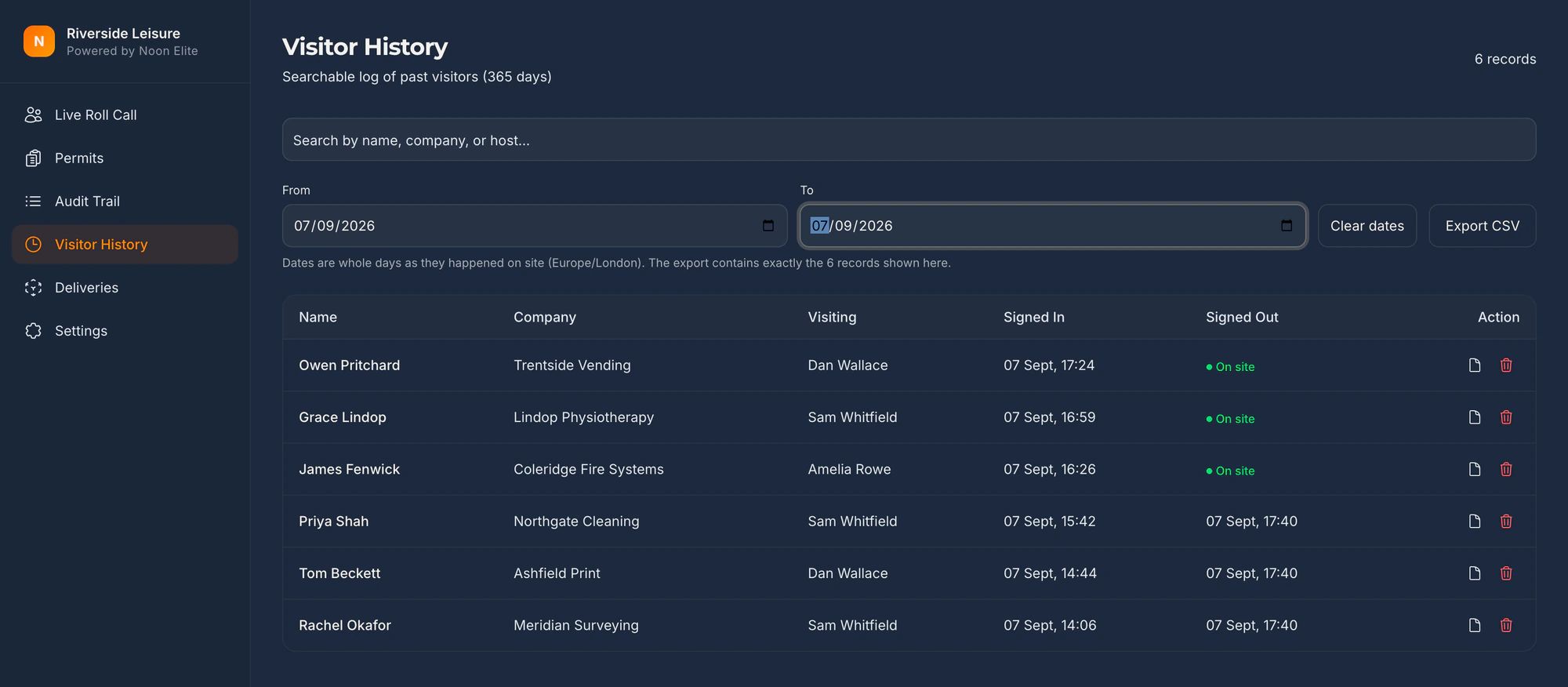
The kiosk does not make a site compliant, certified or audit ready. It produces a timestamped record for the clauses named on this page, and the assessor decides what that record is worth.
The visitor management kiosk in fullAn intake office with nobody in itThe same page for a BRCGS Storage and Distribution warehouseThe food sector page, without the clause numbersIf you make pet food, what the FEDIAF guide says about visitorsOur security and sub-processors
On the day
Five things a UFAS assessor asks at the gate, and where the answers come from
None of these is difficult if the record exists. All of them are awkward if the answer starts with somebody walking to the intake office for the book.
- What security measures do you have against unauthorised access?Your own measures under F 1.2, and beside them a record of every visitor, contractor and driver who signed in, with the host who let them in and both times.
- How are drivers advised about communicable enteric disease before they enter?The line is in the wording on the kiosk, and each driver who signed in accepted it by name with the time. Drivers who stay in the cab are your site rule, and the page says so.
- How are contractors made aware of the eating, drinking and smoking controls?The controls are on the screen at sign in, in your wording, and the acceptance and the exact wording are stored with the visit.
- Who was on site on the day of this complaint?A list filtered to that day, exported to a file the assessor can keep.
- What happens at intake when the office is unstaffed?The driver still signs in and accepts the rules, and the person they named is told in Microsoft Teams or Slack.
See the sign in
A visitor signs in, and the roll call it feeds, in 100 seconds
The sign in that records the accepted rules is the same one that puts the driver on the fire roll call. One action at the gate, two records.
The player loads from YouTube only when you press play. Nothing is sent to Google before that. What happens when you do.
Before you ask
The questions feed mills ask on the first call
Does UFAS require a visitor book?
No clause asks for one by name. F 1.2 requires appropriate and proportionate security measures to monitor and prevent unauthorised access, and the Standard’s Interpretation of it lists control of visitors / contractors among the measures a site may use. F 1.4 to F 1.6 then require that employees, contractors and visitors, including vehicle drivers, are made aware of the site’s controls and advised about enteric disease. A record of who came in, when, and what they accepted is how a site evidences all four, and what your assessor accepts is their decision.
Which version of the UFAS Standard is current?
UFAS Scheme Rules and Standard 2024, Version 1.1, which the document says is effective from 1 April 2025, and which AIC publishes free on agindustries.org.uk. The clause numbers on this page are from it. F 1.6 is marked NEW in that edition and F 1.2, F 1.4 and F 1.5 are marked UPDATED, so a site working from the 2020 Standard should read the 2024 wording before it answers anything.
Do vehicle drivers have to sign in?
The Standard names vehicle drivers in F 1.4, F 1.5 and F 1.6 as people who must be made aware of the controls and advised about enteric disease, so a driver who comes onto the site is inside those clauses. Whether a driver who never leaves the cab signs in is a site rule, and it is yours to set. On the kiosk a driver who signs in gives a vehicle registration and accepts your rules like any visitor; a courier who only uses the delivery drop-off is logged as a delivery and is not a person on the record or the roll call.
Does the kiosk ask whether a visitor has an enteric disease?
No. F 1.6 asks that people are advised that entering with a communicable enteric disease is not permitted; it does not ask for a questionnaire. The kiosk shows your wording, with that line in it, and records that the visitor accepted it, with the time. It asks no questions and stores no answers, so special category health data stays out of the system. The paper questionnaire template on this site has questions and a host’s decision, for sites whose own procedure wants them.
Which activity codes do the F1 clauses apply to?
The F1 Premises heading in the Standard carries Pa, B, C, R, and the Activity Code Matrix on page 17 shows Section F in the clauses for a packaged merchant, a bulk merchant and a compound feed producer. Read the matrix against the codes on your own certificate; this page is written for the compound feed mill and premix plant, code C, and does not try to cover every code.
We also hold a food standard at the same site. Is this the same record?
Yes. The record is the same whichever scheme you certify to: who was here, when, who they saw, and the exact wording they accepted. What changes is the wording on the screen, which is written per site, so a mill that also runs to a food scheme puts both sets of rules in the one text. The BRCGS Storage and Distribution page on this site covers the warehouse clauses, drivers included.
Being straight with you
What this does not do
- We are not AIC Services, a UFAS assessor, a certification body or a feed safety consultancy. This is general information about a published standard, not certification advice.
- The control of visitors and contractors appears in the Standard’s Interpretation of F 1.2, not in the requirement. The page keeps that distinction and so should you when you answer the assessor.
- Four clauses and a heading out of the Standard. Your HACCP, your feed safety risk assessment, your supplier approval and your traceability are still yours, and the assessor spends most of the day on them.
- The kiosk does not open a barrier, a gate or a bin door, does not monitor anything, and does not record vehicles that never stop. A driver is on the record when a person signs in.
- It records that somebody was advised and accepted your rules. Whether they then wore the workwear or ate in the right place is a supervision question, and no software answers it.
- PAS 96:2017, which the Standard points at for guidance under F 1.2, was not read for this page.
Sources
Check any of this yourself
- AIC, UFAS Scheme Rules and Standard 2024, Version 1.1Effective from 1 April 2025, published by the Agricultural Industries Confederation and downloadable without a login. Section F1 and the Activity Code Matrix are quoted from it. Read 26 September 2026.
- AIC, UFAS resource libraryWhere the Standard, the key changes document and the internal audit checklists are published, and the place to check for a newer version.
General information about a published standard, not certification advice. Clause numbers move between versions; confirm against your own copy of the Standard.
Also asked of sites like yours
The other things somebody may ask you to evidence
Each of these is a page about one standard, one duty or one visitor, written the same way as this one: what it actually asks for, what an iPad at reception records towards it, and where it does not help.
Every standard on one page: the clause numbers, the version and the date each was read, on one printable table.
- GDPR and the visitor book
- CMMC physical security
- List X visitor control
- ITAR visitor log
- Def Stan 05-138 visitor access
- ISO 27001 visitor access
- PCI DSS visitor log
- AEO visitor access control
- CTPAT visitor log
- TISAX visitor management
- TAPA FSR visitor log
- BRCGS visitor control
- BRCGS packaging visitor control
- BRCGS storage and distribution visitors
- BRCGS unannounced audit
- Visitor control non-conformity
- SALSA visitor control
- IFS Food visitor hygiene
- GMP visitors in production areas
- GDP wholesale visitor control
- Fire roll call
- Contractor management
- Construction work in occupied premises
- HSE inspection records
- ISO 45001 contractor control
- Visitor NDA sign in
- Visitor record retention
- What a visitor log must contain
- Standards calendar
- Sign in sheet template
- Visitor health questionnaire template
- Contractor induction template
- Permit to work template
- Hot work permit template
- Fire drill record template
Advise sites on this standard? Referral terms are on one page.
Next step
Tell us what your assessor said about the gate
Fifteen minutes on the phone. How many drivers a day, whether the intake office is staffed, what your site rules say today, and what your last assessment raised. We will tell you straight whether a kiosk closes any of it.
Book a 15 minute callNo site visit needed and nothing to install. If it is not a fit we will say so on the call.
Would rather email? [email protected]
Not the person who signs it off? Send them the one page business case