
Pet food manufacturing
Pet food manufacturer visitor hygiene: what the FEDIAF guide says about visitors and contractors
The pet food industry’s own guide to good practice names visitors in two sections, and asks for hygiene standards that are documented and adopted by visitors and contractors. This page quotes those sections by number, says why a paper questionnaire is hard to stand behind months later, and sets out line by line what an iPad at reception records and what it does not.
Sign in on a demonstration kiosk, then open the fire roll call on your phone. Do not enter real details: everything typed is deleted within the hour.
From £599 setup and £150 a month plus VAT, iPad and stand included. We are not food safety consultants.
What the guide says
Two sections that name visitors, and two that reach the front door
The FEDIAF Guide to Good Practice for the Manufacture of Safe Pet Foods, February 2018, is an industry guide. It is not a regulation and not a certification standard. Its introduction says it “does not replace national regulatory requirements and is based on full self-responsibility of the individual pet food manufacturer”. Every line below is quoted from it with its section number.
Section 2.8.2.1, Personnel hygiene
Standards written down, and adopted by visitors
The pet food manufacturer’s personnel hygiene standards must be documented and adopted by all personnel, including contractors and visitors to the factory. These standards must be designed with due regard to the risk of product contamination.
Two verbs, and “must” governs both. Documented is a file. Adopted is each contractor and each visitor, on the day they came.
Section 2.8.2.1, Personnel hygiene
Disease, and who should not enter
Personnel (including visitors) known, or suspected, to be suffering from a disease likely to be transmitted to pet food, should not be allowed to enter any pet food area where direct contact with pet food is possible and there is a likelihood of contaminating the pet food, posing a risk to the safety of the product, the target animal and to humans handling the pet food.
The guide says “should” here, not “must”, and it is about who is allowed in. It names no questionnaire and no form. How your site comes to know or suspect is your own procedure.
Section 2.8.2.2, Workwear & Personnel protective clothing
Protective clothing, and rules that are communicated
Pet food handlers, visitors, and contractors working in, or entering the pet food handling areas, must wear suitable pet food manufacturer-issued protective clothing.
The same section goes on: “Based on risk assessment, the company must document and communicate to all employees, contractors and visitors the rules regarding the wearing and changing of protective clothing in work areas.”
Section 2.1.2, Food defence, biovigilance and bioterrorism
Access to the site
The site boundaries must be clearly defined, and access to the site must be managed.
This section names no visitors. It goes on to say that critical areas “need to be identified and access needs to be controlled”, and gives the inlet of silos as its example.
Section 2.4.1, Equipment
Contractors working on equipment
Third party contractors must be under the supervision of a designated person.
It sits with the guide’s paragraphs on maintenance, after a line on the risk of foreign body contamination.
Quoted from the copy of the guide that UK Pet Food hosts, read on 29 September 2026. The guide calls itself the third version, after 2007 and 2010, and no newer edition was on FEDIAF’s own page or the European Commission’s list on that day. Nothing in the guide names a visitor book, a questionnaire or a record of visitors, and nothing in it tells you to buy anything.
What else you may be asked about
Raw pet food, animal by-products, and a certificate if you hold one
Four more documents, each in its own words. The two certification schemes are here because their own documents name pet food. We link no scheme that does not.
If you make raw pet food
UK Pet Food’s Guidelines for the Manufacture of Raw Pet Food in the UK call themselves “an extension” of the FEDIAF guide, “to be read alongside and not as a replacement”. Section 5.1.2: “Personal hygiene standards should be documented and adopted by all personnel, contractors and visitors to the factory.” Section 5.1.3: “Pet food handlers, visitors and contractors working in, or entering the pet food-handling areas, shall wear suitable issued protective clothing.” Section 2.1.6 asks for “adequate hygiene facilities for plant operators and visitors”. Their cover says they are not “an auditable standard and there is no requirement for companies to be audited against them”.
If your plant uses animal by-products
GOV.UK, from Defra and the Animal and Plant Health Agency: “You need approval from the Animal and Plant Health Agency (APHA) to process animal by-products (ABPs) into pet food.” That page, last updated on 3 March 2026, sets out approval, materials, sampling and packaging. The word visitor does not appear on it, so this page takes no visitor duty from it.
If you hold BRCGS Food Safety
Issue 9 has a section of its own, 5.8, “Pet food and animal feed”. It says that where a site produces pet food or animal feed, “all the relevant requirements” from sections 1 to 7 of the Standard must be fulfilled “in addition to the requirements in this section”. The visitor clauses, 4.1.4 and 7.3.2, are in sections 4 and 7.
If you hold IFS Food
Annex 3 of IFS Food Version 8 lists eleven product scopes, and the eleventh is “Pet food”. The requirements that name visitors are on the IFS page.
All four read on 29 September 2026. The links to each are under Sources, below.
The paper sheet
Why a paper questionnaire is hard to stand behind on the day somebody asks
Documented is the easy half of section 2.8.2.1. Adopted, by this person, on that date, is the half a clipboard has to show months later.
One sheet, for one person, on one date
When the question comes it is about a named contractor on a named day. On paper the proof is one sheet among a year of sheets, and it exists only if it was handed over, filled in and filed that morning.
Which version did they read?
The guide ties the protective clothing rules to your risk assessment, so the wording changes when the risk assessment does. A reprinted form looks like the one before it. To show what a contractor read in March you need the March master as well as their sheet.
Health answers in a folder
A questionnaire that asks about illness collects “data concerning health”, which Article 9 of the UK GDPR lists among the special categories. Every completed sheet is then a record about somebody’s health, and keeping it safe and destroying it on time is one more job for the site.
Nobody between the sheet and the door
The guide’s line on disease is about who is allowed to enter. A sheet does that job only if somebody reads it before the person walks through, and that somebody is a person in your factory, whatever the sheet is printed on.
The same problem on a food site, at more lengthThe paper book and UK GDPR
What the kiosk records
The record, line by line
An iPad at reception with your declaration on it. Every visitor and contractor who signs in gives a name, a company and a named host, and accepts your declaration before the sign in is saved.
There is one declaration per site, and a site with none of its own shows the company’s. There is not one per kind of visitor. A driver, a guest and a contractor who sign in at the same iPad accept the same text.
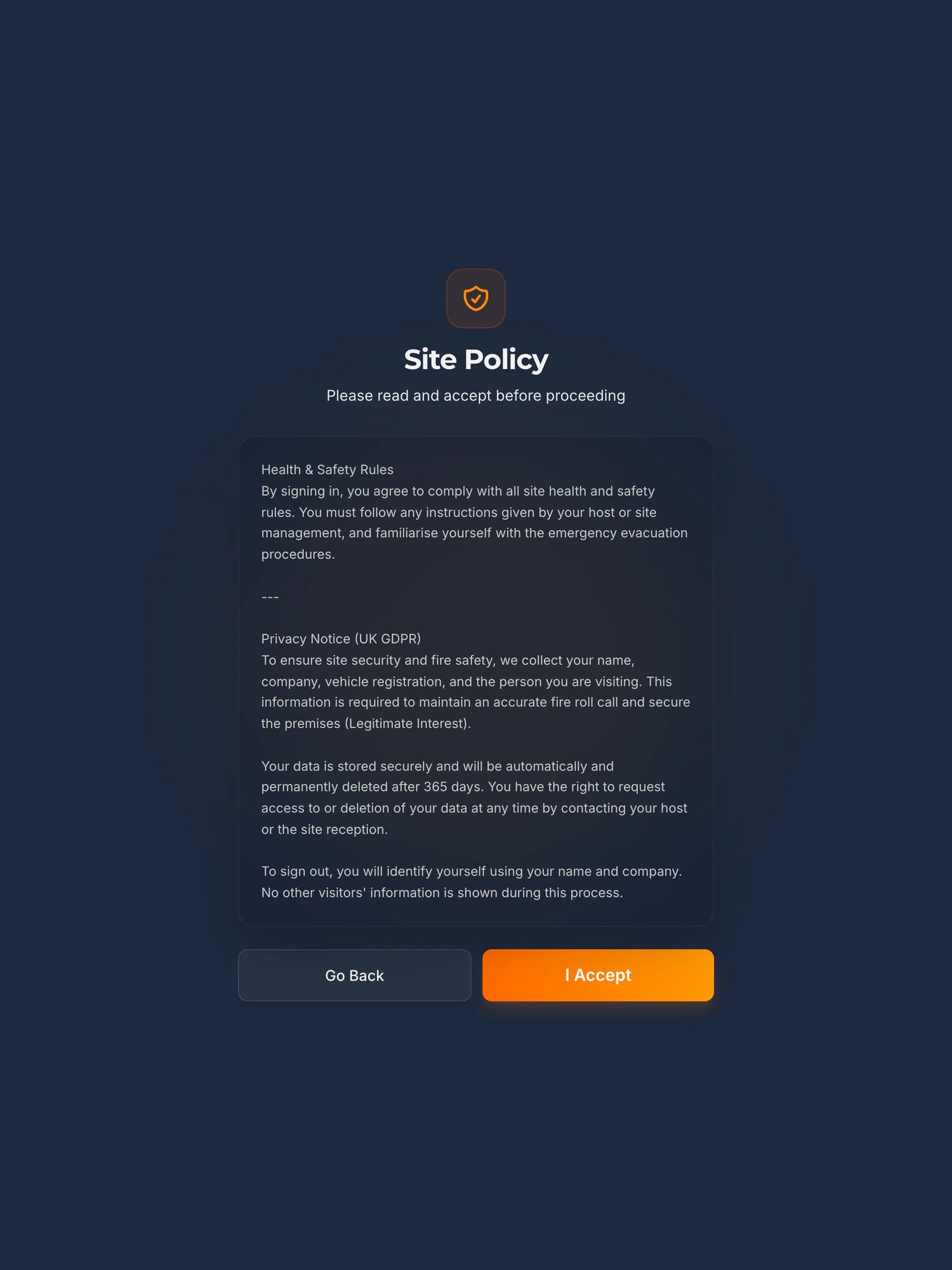
- WhoFull name, company and the person they are visiting, all three required, and a car registration if they give one.
- That they accepted your declarationYour wording follows the form, with two buttons: Go Back and I Accept. The sign in is saved only on I Accept. Go Back returns the visitor to the form, and they are not signed in.
- Which words they acceptedEach wording is stored with a SHA-256 fingerprint when the iPad is given it, and a stored wording cannot be edited. The visit carries the fingerprint, so the History page shows the words that visitor accepted after you have changed them. Where the wording cannot be established, the dashboard says so; it does not put today’s wording in its place.
- WhenThe time in and the time out. Anybody still signed in at 23:59 UTC is signed out automatically, so a forgotten sign out shows that time and not the time they left.
- Who was toldIf you connect a Microsoft Teams or Slack channel, each sign in posts one message to it: the visitor’s name, their company, the person they are visiting and the car registration if they gave one. It is one channel per site, not a message to the host’s own phone.
- Who is on site nowEvery visitor signed in at that site and not yet signed out is on the site’s live roll call. The film below shows it read from a phone.
- What you can get back outSearch the history by name, company or person visited, filter it by date, and export a CSV file of five columns: name, company, visiting, signed in and signed out, in UK time. The accepted wording is read per visitor in the dashboard. It is not a column in the export.
- For how long, and whereOne retention period for your company, from one day to two years, a year if you set nothing, with records deleted automatically when it runs out. The data is held in the European Union, in Ireland.
The visitor management kiosk in fullThe visitor management system for manufacturersHow the accepted wording is keptWhere the data lives
See it work
A sign in and a fire roll call, in 100 seconds
Not filmed in a pet food factory. A visitor signs in on the iPad. The alarm goes. The marshal opens the live list on their phone and reads off who is still on site.
The player loads from YouTube only when you press play. Nothing is sent to Google before that. What happens when you do.
Being straight with you
What the kiosk does not do, and what stays with a person
It asks no questions and keeps no account of anybody’s health.
It shows your declaration and records that it was accepted, with the time and the wording. So the kiosk never holds an account of anybody’s symptoms.
It does not decide who goes in.
The guide’s line on disease is a duty on the site. A visitor who will not accept your declaration presses Go Back and is not signed in. Whether somebody is ill, and whether they enter, is decided by a person in your factory, under your procedure.
It does not issue protective clothing or check that it is worn.
Section 2.8.2.2 is about clothing the manufacturer issues. The kiosk can show your rule before entry and record that it was accepted. Handing over the coat and looking at the person stay with you.
It does not supervise a contractor.
Section 2.4.1 asks for a designated person. The record shows who the contractor said they were visiting, which may not be the person supervising the work.
It takes no signature and checks no identity.
Acceptance is one button. The name is the name the visitor typed.
With Permit to Work, a contractor on a permit is not shown your declaration.
Permit to Work is an early access module, built and not yet run at a customer. Its Contractor route has its own steps and does not show the site wording. On the platform alone, a contractor signs in as any visitor does and accepts the same text.
It does not make a site meet the guide.
It produces a record. What that record is worth is for whoever asks to see it.
We give no advice on hygiene, pathogens, raw meat or animal by-products.
Noon Elite is not a food safety consultancy. This page quotes the documents, links them and stops.
No pet food maker runs the kiosk.
The one customer we name is JK Powell, a metal packaging site in Derbyshire, which has run it since August 2026.
Everything else the kiosk does not doPermit to Work, in early accessThe JK Powell case study
Before you ask
The questions a pet food technical manager asks first
What does the FEDIAF guide say about visitors to a pet food factory?
Three things, in sections 2.8.2.1 and 2.8.2.2. Personnel hygiene standards “must be documented and adopted by all personnel, including contractors and visitors to the factory”. Personnel, including visitors, known or suspected to be suffering from a disease likely to be transmitted to pet food “should not be allowed to enter any pet food area where direct contact with pet food is possible” and contamination is likely. And visitors and contractors entering pet food handling areas “must wear suitable pet food manufacturer-issued protective clothing”, with the rules on it communicated to them.
Does the guide ask for a visitor health questionnaire?
No. The guide names no questionnaire, no visitor book and no record of visitors. It says what must be documented, adopted and communicated, and who should not be allowed to enter. How a site does that is its own procedure. If yours uses a paper questionnaire, there is a free one on this site, written for food sites, with the wording yours to change.
Is the FEDIAF guide law, or a standard we are certified to?
Neither. It is an industry guide. Its introduction says it “does not replace national regulatory requirements and is based on full self-responsibility of the individual pet food manufacturer”, and that Regulation (EC) No 183/2005 on feed hygiene encourages guides of this kind.
Is there a newer edition than February 2018?
Not that we could find on 29 September 2026. The guide calls itself the third version, after 2007 and 2010. FEDIAF’s own safety page still offers the 2018 guide, and the European Commission’s list of guides gives Version 15 (September 2017), assessed by its Standing Committee on 5 to 7 February 2018. Check FEDIAF’s page before you rely on a section number.
We make raw pet food. Does the guide cover us?
The guide’s scope names wet, dry and semi-moist pet food and dog chews. It defines raw pet food in its glossary and does not name it in its scope. UK Pet Food’s Guidelines for the Manufacture of Raw Pet Food in the UK, revision 02.02.22, describe themselves as an extension of the guide, and sections 5.1.2 and 5.1.3 repeat its lines on visitors and contractors, with “should” in 5.1.2 where the guide says “must”.
Does the kiosk ask visitors whether they are ill?
No. It shows your declaration and records that the visitor accepted it, with the time and the wording. It asks nothing and holds nothing about anybody’s health. Whether somebody is ill, and whether they go in, is your site’s decision.
We hold BRCGS Food Safety or IFS Food as well. Is it the same record?
Yes. The record does not change with the document you are asked about: who was here, when, who they came to see, and the wording they accepted. What changes is the wording, which is yours. The clauses of each scheme that name visitors are quoted on the BRCGS and IFS Food pages of this site.
Can drivers, guests and contractors be shown different wording?
No. There is one wording per site, and a site with none of its own shows the company’s. Everybody who signs in at that iPad accepts the same text, so it has to be written for all of them.
Sources
Check any of this yourself
- FEDIAF, Guide to Good Practice for the Manufacture of Safe Pet Foods, February 2018The copy UK Pet Food hosts, 72 pages. Sections 2.1.2, 2.4.1, 2.8.2.1 and 2.8.2.2 and the Introduction are quoted from it. Read 29 September 2026.
- FEDIAF, Safety: the guide on FEDIAF’s own siteThe place to check for a newer edition. It offered the 2018 guide when read on 29 September 2026.
- European Commission, Guides to good practiceLists the guide as Version 15 (September 2017), assessed on 5 to 7 February 2018. Read 29 September 2026.
- UK Pet Food, Guidelines for the Manufacture of Raw Pet Food in the UKPublished 20 September 2017, revision 02.02.22, 48 pages. Sections 2.1.6, 5.1.2 and 5.1.3 are quoted. Read 29 September 2026.
- GOV.UK, Using animal by-products to make pet foodDefra and the Animal and Plant Health Agency, last updated 3 March 2026. Quoted for approval only. Read 29 September 2026.
- BRCGS, Food Safety Issue 9 auditor checklist and self-assessment tool, F904aSection 5.8, Pet food and animal feed. The Standard itself is sold by BRCGS and was not read. Read 29 September 2026.
- IFS Food Version 8, April 2023Annex 3, product scopes. Read 29 September 2026.
- UK GDPR, Article 9For “data concerning health”. Read 29 September 2026.
General information about published documents, not food safety advice. Section numbers move between editions; confirm against your own copy.
What it costs
One price, in public
Setup from £599, then £150 a month plus VAT per site for the platform. The iPad and the stand are included and replaced if they fail, and nothing is charged per visitor. The two modules, Secure Badge and Approval and Permit to Work, are £150 a month each.
Every price, and what is not charged forWho you would be dealing with
Still on paper for now?
The free visitor health questionnaire on this site was written for food sites. It prints on one page and comes as a Word file, so the wording is yours to change.
Next step
Tell us what you ask at the door today
Fifteen minutes on the phone. How many doors people come through, who comes through them, and what your declaration says now. We will tell you straight whether a kiosk is worth your time.
Book a 15 minute callNo site visit needed and nothing to install. If it is not a fit we will say so on the call.
Would rather email? [email protected]
Not the person who signs it off? Send them the one page business case