
SALSA Issue 7 and small food producers
SALSA audit visitors: what Issue 7 asks you to show about the people at your door
Your auditor signs your visitor book before they look at anything else, and the clause they are thinking about while they do it is 1.2.7, the one that says visitors and contractors notify you of illness before they go in. This page quotes the five clauses of Issue 7 that reach your reception, from the Standard itself, and says what an iPad at the door records towards each of them.
Sign in on a demonstration kiosk, then open the fire roll call on your phone. Do not enter real details: everything typed is deleted within the hour.
From £150 a month plus VAT, iPad and stand included. We are not auditors, mentors or consultants.
What the Standard asks
No clause is headed visitors. Five of them reach the front door anyway
Issue 7 has no visitor section and no clause that asks for a visitor book. It asks for procedures, and for evidence that they reach the people they cover. Three clauses name visitors and contractors in their own words, one controls who may enter production and storage, and one turns on a single word: evident.
Clause 1.2.7
Health status, and who has to notify you
The business shall have a procedure for establishing the health status of food handlers and for the notification by employees, temporary employees, contractors and visitors of any relevant infectious disease or condition with which they may be suffering or have been in contact with.
The one clause that names visitors and contractors beside your own staff, and the one your reception is being asked to satisfy. It asks for two things: a procedure, and a notification that actually happens. A visitor has to be asked before they go in, and you have to be able to show that they were.
Clause 1.2.2
Protective clothing for visitors and contractors
Protective clothing, workwear and footwear worn by employees, visitors and contractors working in, or entering food handling/storage areas shall be suitable for the food being handled and shall not pose a contamination risk to the product.
Issue 7 adds footwear and now asks for a procedure. A visitor going past the barrier is held to the same rule as a line operative, so the rule has to reach them before they get there, not on the way through.
Clause 1.2.1
Hygiene rules, understood and implemented
It shall be evident that these rules are understood and implemented by all personnel to prevent product contamination.
Evident is the auditor’s word. For a member of staff it means a training record. For a contractor on site for a morning it means whatever you can show about the moment they were told the rules, which a book on the counter does not record.
Clause 4.2.3
Food security and defence plan
The plan shall always include the security measures and/or practices to ensure only authorised personnel have access to production and storage areas on site.
A plan that says who may go where is half of it. The other half is being able to say who was in the building on a given day, and who let them in. That is where a visitor record earns its place in a SALSA audit, although no clause asks for one by name.
Clause 4.3.3
Visitor tours and tastings
A procedure shall be in place detailing the controls required for the management of visitor tours & tastings.
New in Issue 7. If buyers, schools or customers walk your site, the controls for that need writing down, and a record of who came through, when, and what they accepted before they did is the obvious first line of it.
Quoted from the SALSA Food & Drink Production Audit Standard, Issue 7, June 2026, read on 26 September 2026. SALSA audits have been conducted against Issue 7 since 1 September 2026. Nothing in the Standard tells you to buy anything: a paper sheet that is genuinely filled in every time can satisfy 1.2.7. What paper struggles with is the second half of the clause, showing that the notification happened, for a contractor who was here for one morning eight months ago.
At the door
What the kiosk records towards each clause
The same iPad every site gets, showing your declaration. On a food site the declaration is the point: a name and a time is a log, and a name, a time and an accepted health declaration is the evidence 1.2.7 asks for.
The declaration, accepted before entry
Your health declaration under 1.2.7, in your own wording, on the iPad at sign in. The visitor reads it and accepts the declaration before they can sign in, or presses Go Back and speaks to their host. The kiosk asks no questions and stores no answers: it records that this person accepted this exact wording at this time.
Rules that reach contractors as well as guests
Protective clothing, jewellery, allergen and glass rules go in the same text, so a contractor and a buyer read the same thing and each acceptance is stored against the named person with a timestamp. Change a word and the kiosk stores a new wording; earlier acceptances keep pointing at the wording they saw.
Who was in the building, on the day
Filter the record by date, by company or by host and export it as a file that opens without our software. A customer complaint traced to a Tuesday becomes a list of who was on site that Tuesday, rather than a search through last quarter’s folder.
A roll call that includes contractors
Everyone signed in on the kiosk is on a live list readable from any phone at the assembly point. A courier who only uses the delivery drop-off is logged as a delivery, not as a person on site, so drivers who go beyond goods in should sign in.
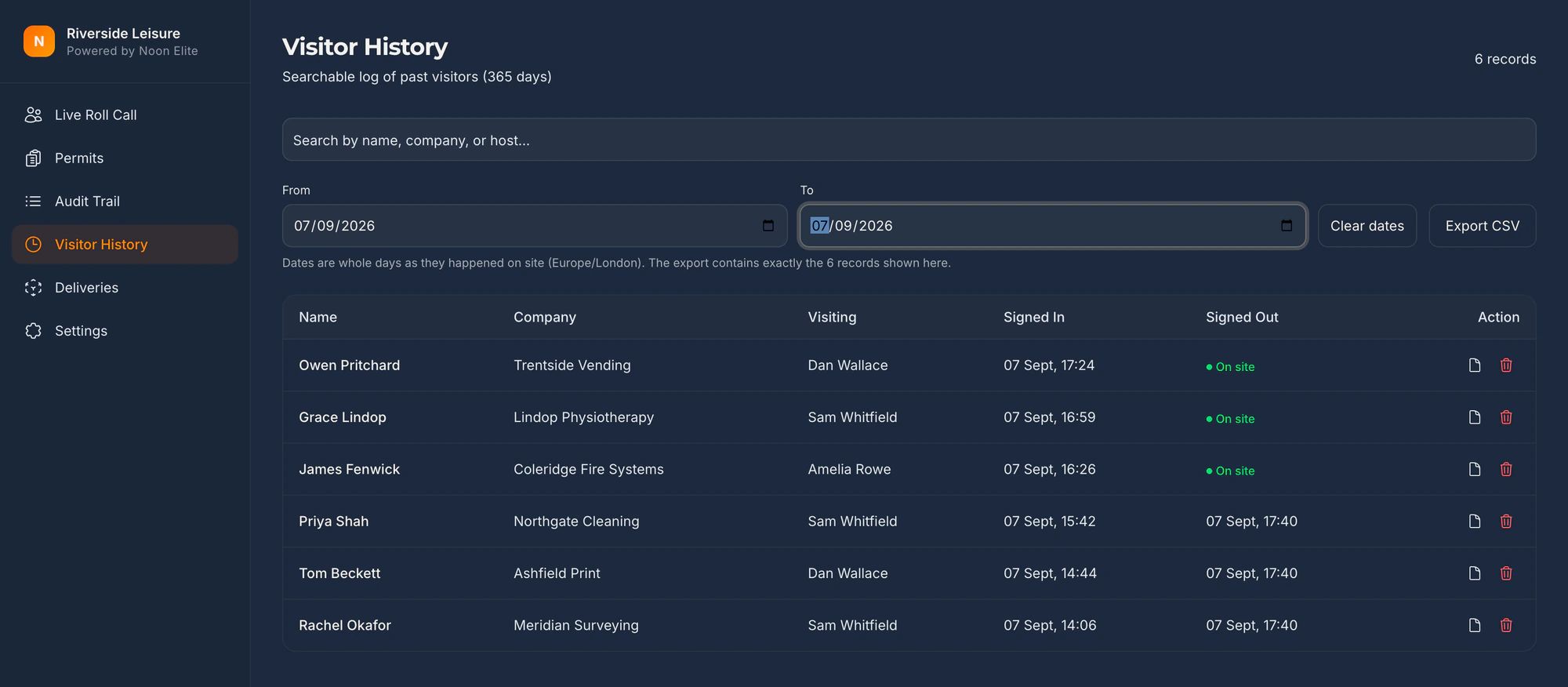
The kiosk does not make a site compliant, certified or audit ready. It produces a timestamped record for the clauses named on this page, and the auditor decides what that record is worth.
The visitor management kiosk in fullThe food sector page, without the clause numbersFree visitor health questionnaire templateThe same page for BRCGS Issue 9Our security and sub-processors
On the day
Five things a SALSA auditor asks at reception, and where the answers come from
None of these is difficult if the record exists. All of them are awkward if the answer starts with somebody going to look for a folder.
- How do visitors and contractors notify you of illness before they go in?The declaration on the kiosk, in your wording, and the record of each person who accepted it with the time.
- How do you know a contractor understood the hygiene rules?The rules were on the screen at sign in and were accepted by name. The acceptance and the exact wording are stored with the visit.
- Who was on site on the day of this complaint?A list filtered to that day, exported to a file the auditor can keep.
- How do you keep unauthorised people out of production and storage?Your food defence plan, and beside it a record of who was let in, by whom and when. The kiosk does not open doors; it records who came through the one it sits by.
- What happens when nobody is at the front desk?The visitor still signs in and accepts the declaration, and their host is told by name in Microsoft Teams or Slack.
See the sign in
A visitor signs in, and the roll call it feeds, in 100 seconds
The sign in that records the accepted declaration is the same one that puts the visitor on the fire roll call. One action at the door, two records.
The player loads from YouTube only when you press play. Nothing is sent to Google before that. What happens when you do.
Before you ask
The questions SALSA sites ask on the first call
Does SALSA require a visitor book?
No clause in Issue 7 asks for a visitor book or a visitor recording system by name. Clause 1.2.7 asks for a procedure under which visitors and contractors notify you of illness or contact with infection, and clause 4.2.3 for a plan that keeps unauthorised people out of production and storage areas. Both are easier to evidence with a record of who came in, when, and what they accepted at the door, which is why most SALSA sites keep one, on paper or otherwise.
Which issue of the SALSA Standard is current?
Issue 7 of the Food & Drink Production Audit Standard, dated June 2026. SALSA says all audits are conducted against the new issues from 1 September 2026. The clause numbers on this page are Issue 7’s; if you are reading an Issue 6 copy, 4.3.3 will not be there and 4.2.3 will still contain the digital security wording that Issue 7 moved to 4.2.4.
We have a handful of staff. Is a kiosk sensible at our size?
SALSA is written for businesses employing between one and fifty full-time people, and honestly, at the smaller end a paper sheet that is filled in every single time can satisfy 1.2.7. The kiosk is £150 a month plus VAT with the iPad and stand included and setup from £599, and it earns that when the sheet is not being filled in every time, when the folder cannot be found on audit day, or when the same site also needs the fire roll call. If it is not a fit at your size we will say so on the call.
Does the kiosk ask the health questions?
No. It shows your declaration and records that the visitor accepted it, with the wording and the time. It does not ask for or store an account of anybody’s symptoms, so special category health data stays out of the system. Anyone who cannot accept the declaration goes back and speaks to their host, and what happens next is your record, not the kiosk’s. The paper questionnaire template on this site does have questions and a host’s decision, because paper can.
What about delivery drivers?
A driver who signs in as a visitor accepts the same declaration as everyone else and is on the record and the roll call. A courier who only uses the delivery drop-off is logged as a delivery, with the time and the carrier, and is not treated as a person on site. Whether a driver who stays in the yard signs in is a site rule, and it is yours to set.
We are moving from SALSA to BRCGS. Does the record carry over?
The record is the same whichever scheme you certify to: who was here, when, who they saw, and the exact wording they accepted. What changes is the wording you put on the screen, which is written per site. The BRCGS page on this site covers Issue 9 clause 4.1.4 and the clauses around it.
Being straight with you
What this does not do
- We are not a certification body, a SALSA auditor, a SALSA mentor or a food safety consultancy. This is general information about a published standard, not certification advice.
- The SALSA Interpretation Guide, which says how each clause is assessed, is a member resource behind a login. We have not read it. This page quotes the Standard and stops there.
- Five clauses out of the Standard. Your HACCP plan, your prerequisite programmes and your traceability tests are still yours, and the auditor spends most of the day on them.
- The kiosk lives at reception, on the office side of the hygiene barrier. It is a consumer tablet in a stand, not a washdown-rated device.
- It records that somebody accepted your declaration and your rules. Whether they then followed them is a supervision question, and no software answers it.
- If your auditor has raised a non-conformance, bring their wording to the call and we will tell you honestly whether this closes it.
Sources
Check any of this yourself
- SALSA Food & Drink Production Audit Standard, Issue 7, June 2026The Standard itself, published by SALSA Scheme Ltd and downloadable without a login. Every clause on this page is quoted from it. Read 26 September 2026.
- SALSA, new Standard issues 2026Where the four new issues are published, with the 1 September 2026 date from which audits use them.
- SALSA, Issue 7 Summary of ChangesSALSA’s own list of what moved between Issue 6 and Issue 7, in Issue 7 numbering. The source for footwear in 1.2.2, the annual review in 4.2.3 and the new 4.3.3.
- Food Standards Agency, managing food safetyThe statutory baseline underneath the scheme, which applies whether or not you are certified.
General information about a published standard, not certification advice. Clause numbers move between issues; confirm against your own copy of the Standard.
Also asked of sites like yours
The other things somebody may ask you to evidence
Each of these is a page about one standard, one duty or one visitor, written the same way as this one: what it actually asks for, what an iPad at reception records towards it, and where it does not help.
Every standard on one page: the clause numbers, the version and the date each was read, on one printable table.
- GDPR and the visitor book
- CMMC physical security
- List X visitor control
- ITAR visitor log
- Def Stan 05-138 visitor access
- ISO 27001 visitor access
- PCI DSS visitor log
- AEO visitor access control
- CTPAT visitor log
- TISAX visitor management
- TAPA FSR visitor log
- BRCGS visitor control
- BRCGS packaging visitor control
- BRCGS storage and distribution visitors
- BRCGS unannounced audit
- Visitor control non-conformity
- IFS Food visitor hygiene
- UFAS feed mill visitor control
- GMP visitors in production areas
- GDP wholesale visitor control
- Fire roll call
- Contractor management
- Construction work in occupied premises
- HSE inspection records
- ISO 45001 contractor control
- Visitor NDA sign in
- Visitor record retention
- What a visitor log must contain
- Standards calendar
- Sign in sheet template
- Visitor health questionnaire template
- Contractor induction template
- Permit to work template
- Hot work permit template
- Fire drill record template
Advise sites on this standard? Referral terms are on one page.
Next step
Tell us what your auditor said about reception
Fifteen minutes on the phone. How many people come through the door in a week, what your declaration says today, and what your last audit raised. We will tell you straight whether a kiosk closes any of it.
Book a 15 minute callNo site visit needed and nothing to install. If it is not a fit at your size we will say so on the call.
Would rather email? [email protected]
Not the person who signs it off? Send them the one page business case